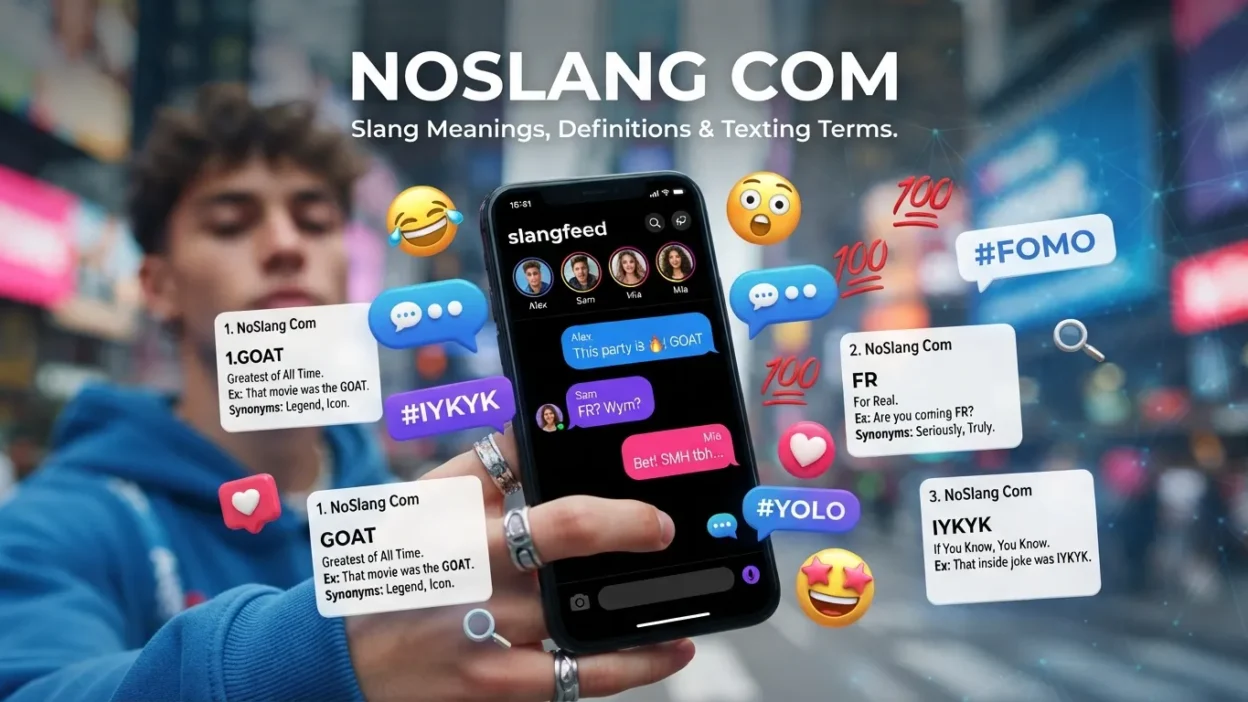
NoSlang com, commonly written as NoSlang.com, is a website dedicated to internet slang, text abbreviations, acronyms, and online language.
It provides a slang dictionary and translation tools that help users understand unfamiliar terms found in texts, chats, social media, gaming, and other digital conversations.
Key Takeaways
- NoSlang.com is an internet and text slang dictionary and translator.
- It helps explain abbreviations, acronyms, alternate spellings, and other forms of online shorthand.
- Users can search individual terms or explore its alphabetical slang dictionary.
- The site also offers a slang translator, rejected-term lists, quizzes, and other slang-related resources.
- NoSlang says its database is largely user submitted, so context is important when interpreting definitions.
What Is NoSlang Com?
If you searched “noslang com,” you are probably looking for NoSlang.com, a website focused on understanding internet and text slang.
Unlike a standard English dictionary, NoSlang is designed around the shortened words, acronyms, unusual spellings, and expressions commonly found in digital communication. The site explains that its main purpose is to translate slang and acronyms rather than translate one spoken language into another.
This makes it useful when you receive a message containing an abbreviation you do not recognize.
For example, someone might send “NGL, that was funny” or “BRB, I have to go.” A person unfamiliar with texting language may need to look up the abbreviation before understanding the message.
NoSlang provides definitions for these types of expressions and organizes many of them in an alphabetical dictionary.
Visit NoSlang.com
What Can You Find on NoSlang?
NoSlang is more than a single search box. Its website includes several tools and sections designed around internet language. Its sitemap lists a text slang dictionary, slang-to-text and text-to-slang translators, rejected words, quizzes, Slangle, slang guides, and additional specialized resources.
Internet and Text Slang Dictionary
The core feature is its internet and text slang dictionary.
You can browse slang alphabetically or search for individual terms. Dictionary pages contain abbreviations and expressions together with their meanings. For example, the site’s N section includes entries such as nvm for “never mind,” ngl for “not gonna lie,” and np for “no problem.”
This alphabetical approach can be useful when you know the spelling of an abbreviation but do not know what it means.
Slang Translator
NoSlang also provides a translator designed specifically for slang and acronyms.
The difference is important. A normal translation service usually converts text from one language to another. NoSlang focuses on converting internet shorthand and slang into more understandable language.
This can be helpful when a message contains several abbreviations or unusual forms of online writing.
Rejected Slang Dictionary
One interesting part of NoSlang is its rejected slang section.
Not every submitted term becomes part of the main dictionary. NoSlang explains that terms considered insufficiently common may be placed in its rejected collection instead. The site says accepted terms generally need to be widely used online.
This gives users another place to look when a slang term does not appear in the main dictionary.
Slang Quiz and Slangle
NoSlang also includes interactive features.
Its Internet & Text Slang Quiz asks users to identify common meanings of terms such as LOL, BRB, GF, and NOOB.
Another feature called Slangle works like a word-guessing game, but the answers are acronyms or abbreviations from the site’s slang dictionary.
These features make the site useful not only as a reference tool but also as a way to become more familiar with online shorthand.
How to Use NoSlang Com
Using NoSlang to understand an unfamiliar term is straightforward.
Step 1: Search for a Slang Term
Start with the abbreviation, acronym, or slang expression you do not understand.
For example, if someone sends you “NVM”, search for that term in the NoSlang dictionary.
Step 2: Read the Definition
Look at the definition provided by the dictionary. NoSlang’s individual search pages can also provide examples showing how a term may appear in a message.
Step 3: Check the Context
Do not assume that every slang term has only one possible meaning.
An abbreviation can have different meanings depending on the conversation, platform, community, or subject. Even a useful slang dictionary should therefore be treated as a reference rather than an automatic interpretation of every message.
This is especially important with newer slang, gaming terms, social-media expressions, and abbreviations that are used differently by different groups.
What Kind of Slang Does NoSlang Cover?
The site covers a broad range of internet and text language.
Examples include:
- Acronyms
- Text-message abbreviations
- Internet slang
- Alternate spellings
- Chat shorthand
- Social-media terminology
- Gaming-related expressions
- Common online phrases
- Emoticons and related digital expressions
NoSlang’s own explanation of text slang describes it as informal, abbreviated language used in text messages and other digital communication. It notes that abbreviations, symbols, emojis, creative word usage, and platform-specific terminology can all be part of text slang.
The dictionary also contains terms that may be mature, offensive, sexual, or otherwise unsuitable for children. Users should keep that possibility in mind when browsing unfamiliar entries.
Can You Add a New Slang Term?
Yes. NoSlang provides a submission form for users who believe a slang term is missing.
However, the site provides specific submission guidelines. It asks users to submit internet, IM, or chat-related terms and recommends using correct spelling and the most common usage. It also explains that some categories and alternate forms are not accepted.
This user-submission model helps the dictionary expand as online language changes.
That matters because internet slang can develop quickly. New abbreviations and expressions can become popular on social platforms, messaging apps, gaming communities, and online forums.
NoSlang Com vs. a Regular Dictionary
A traditional dictionary and NoSlang serve different purposes.
| Feature | NoSlang | Traditional Dictionary |
| Internet slang | Yes | Limited |
| Text abbreviations | Yes | Limited |
| Acronyms | Strong focus | Yes |
| Standard English words | Not the main focus | Yes |
| Online shorthand | Yes | Limited |
| Slang examples | Available for many terms | Varies |
| Slang translator | Yes | Usually not the main purpose |
| Rejected slang section | Yes | No |
If you want the meaning of a standard English word, a traditional dictionary may be more appropriate. If you are trying to understand text slang, chat abbreviations, or internet shorthand, a specialized resource such as NoSlang can be more relevant.
Why Context Matters When Decoding Slang
Finding a definition is only the first step.
Slang is highly dependent on context. A term may have one meaning in texting, another in gaming, and a completely different meaning in a professional or technical setting.
NoSlang itself explains that its database contains common slang and acronym meanings, while its submission guidelines emphasize using the most common usage.
For that reason, consider these questions when decoding a message:
- What platform was the message sent on?
- What was the conversation about?
- Who sent the message?
- Does the surrounding sentence support the dictionary definition?
- Could the abbreviation have another common meaning?
Context can prevent a simple dictionary lookup from becoming a misunderstanding.
Is NoSlang Useful for Parents, Students, and Everyday Users?
NoSlang was originally created partly because its founder encountered unfamiliar shorthand in instant messages. According to the site’s FAQ, Ryan Jones started NoSlang in 2005 after struggling to understand messages from relatives on AOL Instant Messenger. He subsequently developed a database of slang terms.
That background explains the site’s practical purpose.
Parents may use a slang dictionary to understand unfamiliar language in messages or social-media conversations. Students may encounter abbreviations while participating in online communities. Everyday users can use it when a friend sends a phrase they have never seen before.
The important point is that a slang dictionary should help with understanding, not replace judgment about what a message means.
FAQs:
What is NoSlang.com?
NoSlang.com is an online resource for internet slang, text slang, acronyms, and related digital language. It includes a searchable slang dictionary and translation tools designed to help users understand unfamiliar online expressions.
Is NoSlang a slang translator?
Yes. NoSlang describes itself as a translator that focuses on slang and acronyms rather than translating between conventional languages. Its website also lists separate slang-to-text and text-to-slang tools.
Who created NoSlang?
According to NoSlang’s official FAQ, the site was started by Ryan Jones in 2005. The site says the project grew from his experience trying to understand unfamiliar shorthand used in instant messaging.
Can I submit slang to NoSlang?
Yes. NoSlang has a slang submission form. Its guidelines ask contributors to submit relevant internet, IM, or chat slang and to provide the most common usage.
Does NoSlang cover more than internet slang?
Yes. Its broader site includes resources covering areas such as British slang, gaming terminology, drug slang, sexting terminology, commonly misused words, and other slang-related subjects.
Conclusion:
NoSlang com, or NoSlang.com, is primarily a specialized resource for understanding internet and text slang.
Its main dictionary helps users look up abbreviations, acronyms, and online expressions, while its translator and additional tools provide other ways to explore digital language.
The site also includes a rejected slang collection, quizzes, Slangle, submission tools, and educational resources.
If you found an unfamiliar abbreviation in a text, chat, social-media post, or gaming conversation, NoSlang can be a useful starting point.
Just remember that slang changes quickly and meanings can depend heavily on context, so a dictionary definition should always be considered alongside the actual conversation.

I am Kazuo Ishiguro, a creative mind behind the witty words and clever humor you find on Punsarena.com.
I am passionate about turning everyday moments into smart, trending, and shareable puns that make people smile.
I am here to keep your humor fresh, your captions sharp, and your laughs coming back for more.