
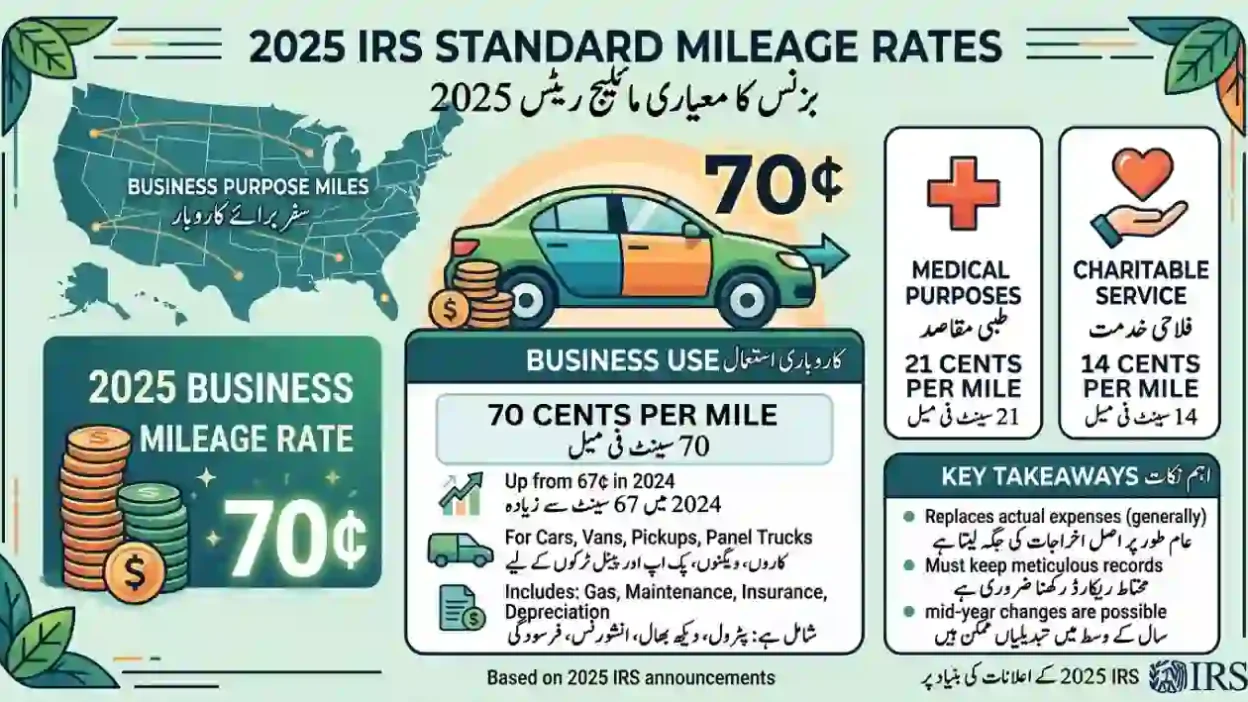
The business mileage rate for 2025 was 70 cents per mile, according to the IRS. Effective January 1, 2025, this optional standard mileage rate applied to eligible business driving in cars, vans, pickups, and panel trucks. Business owners and self-employed taxpayers could use it to calculate qualifying vehicle expenses for tax purposes.
Source: IRS standard mileage rates.
GovDelivery+1
Key Takeaways
- The 2025 IRS business mileage rate was 70 cents per mile, up from 67 cents in 2024.
- Driving 1,000 qualifying business miles equals a potential $700 vehicle expense deduction under the standard mileage method.
- Business trips must qualify under IRS rules; ordinary commuting generally does not.
- You must keep accurate mileage records, including dates, destinations, business purposes, and miles driven.
- You generally cannot deduct actual vehicle operating costs separately when using the standard mileage method, although eligible parking fees and tolls may be deductible.
Introduction
The business mileage rate 2025 is the IRS standard rate used to calculate eligible vehicle expenses for business driving during the 2025 tax year. The rate was 70 cents per mile, an increase of 3 cents from the 2024 rate of 67 cents.
GovDelivery
This rate matters to freelancers, independent contractors, small business owners, and other eligible taxpayers who use a personal vehicle for work. Instead of adding up every expense for fuel, maintenance, insurance, and depreciation, eligible taxpayers can use the standard mileage method to calculate qualifying vehicle costs.
However, not every mile driven qualifies as business mileage, and the standard rate is not automatically a tax refund or an amount every employer must pay. Your eligibility depends on the type of trip, your tax situation, and IRS recordkeeping rules.
In this guide, you’ll learn how the 2025 rate works, how to calculate a potential deduction, which trips qualify, what records to keep, and when the actual-expense method may be more suitable.
What Does “Business Mileage Rate 2025” Mean?
The business mileage rate is a standard amount assigned to each qualifying business mile driven in a vehicle. The IRS sets this rate to help taxpayers estimate deductible vehicle operating costs without tracking every individual expense.
For 2025, the rate was $0.70 per business mile. It applied from January 1 through December 31, 2025, to eligible business use of cars, vans, pickups, and panel trucks, including gasoline, diesel, hybrid, and fully electric vehicles.
GovDelivery+1
People commonly use this rate when calculating business vehicle expenses for tax returns or establishing mileage reimbursement policies. However, the IRS standard rate is an optional tax calculation method, not a universal reimbursement requirement for private employers.
Which Trips Usually Qualify?
Examples of potentially qualifying business trips include:
- Driving from your office to a client’s workplace for a meeting.
- Traveling between two business locations during the workday.
- Visiting a supplier or picking up materials for your business.
- Driving to a temporary work location when the trip meets IRS requirements.
- Traveling between qualifying business appointments as a self-employed professional.
Ordinary commuting generally does not qualify. Driving from your home to your regular workplace is usually personal commuting, even when you use your car for work afterward. Special rules may apply to certain home offices, temporary work locations, and other travel situations. See the IRS Publication 463 for details.
Internal Revenue Service
Why Use the Standard Business Mileage Rate?
The standard mileage method can simplify vehicle expense calculations. Rather than tracking each operating cost separately, you multiply eligible business miles by the applicable IRS rate.
Benefits include:
- Simpler calculations: One rate covers many vehicle operating costs.
- Easier recordkeeping: You still need mileage records, but you do not have to total every eligible operating expense.
- More predictable estimates: You can estimate potential deductible vehicle costs before preparing your tax return.
- Less administrative work: This approach may be easier for freelancers and small business owners.
- A clear comparison: You can compare the standard method with eligible actual expenses to see which works better.
The method is not always the most advantageous choice. If your vehicle has high operating costs or you drive relatively few business miles, calculating actual expenses may produce a different result. Compare the methods using your own records and applicable tax rules.
How to Calculate the 2025 Business Mileage Rate
The calculation is straightforward:
Qualifying business miles × $0.70 = potential standard mileage deduction
For example, if you drove 2,000 qualifying business miles in 2025, your calculation would be:
2,000 × $0.70 = $1,400
This represents the vehicle expense amount calculated under the standard mileage method, assuming the miles qualify and you meet the applicable requirements. It does not mean you automatically receive $1,400 from the IRS.
2025 Business Mileage Calculation Examples
| Qualifying business miles | Rate per mile | Calculated amount |
|---|---|---|
| 100 miles | $0.70 | $70 |
| 500 miles | $0.70 | $350 |
| 1,000 miles | $0.70 | $700 |
| 2,000 miles | $0.70 | $1,400 |
| 5,000 miles | $0.70 | $3,500 |
| 10,000 miles | $0.70 | $7,000 |
Use only eligible business miles in these calculations. Personal trips, ordinary commuting, and other nonqualifying travel should not be included.
Business Mileage Rate 2025 vs. 2024
The IRS increased the business mileage rate for 2025 by 3 cents per mile. The following comparison shows the change.
GovDelivery+1
| Tax year | Standard business mileage rate |
|---|---|
| 2024 | $0.67 per mile |
| 2025 | $0.70 per mile |
For someone who drove 10,000 qualifying business miles, the standard mileage calculation increased from $6,700 in 2024 to $7,000 in 2025, a difference of $300.
This comparison assumes the same number of qualifying miles in each year. It does not establish the actual tax savings because the final result depends on the taxpayer’s circumstances.
Other IRS Mileage Rates for 2025
The IRS established different standard mileage rates for business, medical, military moving, and charitable travel. These rates are not interchangeable; you must use the rate that applies to the purpose of your trip.
GovDelivery+1
| Travel purpose | 2025 rate per mile | Important detail |
|---|---|---|
| Business | $0.70 | Qualifying business driving |
| Medical | $0.21 | Eligible medical travel |
| Military moving | $0.21 | Qualified active-duty military members only |
| Charitable service | $0.14 | Driving in service of qualifying charitable organizations |
The medical and military moving rates were 21 cents per mile, while the charitable rate was 14 cents per mile. The general moving expense deduction remained unavailable to most taxpayers, with an exception for qualifying active-duty military moves under applicable rules.
GovDelivery+1
Standard Mileage Method vs. Actual Vehicle Expenses
When calculating eligible business vehicle costs, taxpayers may be able to choose between the standard mileage method and the actual-expense method. The right choice depends on the vehicle, qualifying business use, available records, and IRS restrictions.
Standard Mileage Method
Under this method, you multiply qualifying business miles by 70 cents for the 2025 tax year.
The rate accounts for various vehicle operating costs, including fuel, oil, maintenance, repairs, insurance, and depreciation. You generally cannot deduct these costs separately for the same vehicle and year when using the standard mileage method.
Eligible business parking fees and tolls may be deductible separately. Certain business-related vehicle loan interest may also qualify, subject to the applicable rules.
Internal Revenue Service+1
Actual-Expense Method
With the actual-expense method, you calculate eligible vehicle costs, such as:
- Gasoline or electricity used to charge an electric vehicle.
- Repairs and maintenance.
- Insurance premiums.
- Vehicle registration fees.
- Depreciation or eligible lease costs.
- Other qualifying operating expenses.
If you use the vehicle for both business and personal travel, you generally must allocate expenses based on the qualifying business-use percentage. Special depreciation and vehicle deduction limits may also apply.
Important: If you own a vehicle and want to use the standard mileage method, you generally must choose it in the first year the vehicle is available for business use to preserve the option to switch methods in later years. For a leased vehicle, choosing the standard mileage method generally requires using it throughout the entire lease period, including renewals. Review IRS rules before deciding.
GovDelivery+1
Common Business Mileage Mistakes
Avoid these five common errors when calculating your 2025 business mileage.
1. Including personal commuting miles. Driving from home to your regular workplace generally counts as commuting, not deductible business travel.
2. Treating the rate as a guaranteed reimbursement. The IRS standard mileage rate helps calculate eligible tax deductions. Private employers generally are not required to reimburse employees at exactly 70 cents per mile.
3. Deducting the same expenses twice. When using the standard mileage method, you generally cannot deduct fuel, repairs, insurance, and other covered vehicle costs separately. Eligible parking fees and tolls are exceptions.
4. Failing to keep mileage records. A rough estimate may not provide adequate support for a deduction. Record your trips and preserve supporting documentation.
5. Using the wrong year’s rate. The 2025 business rate was 70 cents per mile, while the 2024 rate was 67 cents. Apply the rate that corresponds to the date of the travel.
How to Keep a Business Mileage Log
Good records help support your deduction if the IRS asks you to substantiate your travel. Create a mileage log during the year rather than trying to reconstruct every trip at tax time.
Your log should include:
- Date: When the business trip occurred.
- Starting point and destination: Where you traveled from and to.
- Business purpose: Why the trip was necessary for your work.
- Miles driven: The qualifying business distance.
- Supporting documents: Relevant calendars, appointment records, receipts, or other evidence.
You can use a spreadsheet, a paper logbook, or a mileage-tracking app. Choose a method that makes it easy to maintain accurate, timely records.
For more information about documentation and deductible vehicle expenses, consult IRS Publication 463: Travel, Gift, and Car Expenses.
Internal Revenue Service
Frequently Asked Questions
1. What was the business mileage rate for 2025?
The IRS business mileage rate for 2025 was 70 cents per mile, effective January 1 through December 31, 2025. Eligible taxpayers could use this rate to calculate qualifying business vehicle expenses. The rate applied to cars, vans, pickups, and panel trucks, including electric and hybrid vehicles.
GovDelivery
2. How much is 1,000 business miles worth in 2025?
At the 2025 rate of 70 cents per mile, 1,000 qualifying business miles equal $700 in calculated vehicle expenses. This amount is not a guaranteed refund or employer payment. Your actual tax benefit depends on your eligibility, business circumstances, and how the deduction affects your taxable income.
3. Did the IRS increase the business mileage rate in 2025?
Yes. The IRS increased the standard business mileage rate from 67 cents per mile in 2024 to 70 cents per mile in 2025. That was an increase of 3 cents per mile. For someone driving 5,000 qualifying business miles, the higher rate adds $150 to the calculated amount compared with the previous rate.
GovDelivery+1
4. Can self-employed people deduct business mileage?
Yes. Eligible self-employed taxpayers can generally use the standard mileage method or the actual-expense method to calculate qualifying business vehicle costs. They must follow IRS requirements, distinguish business travel from personal driving, and maintain supporting records. The correct deduction depends on the taxpayer’s circumstances and the expenses being claimed.
5. Does the 2025 business mileage rate apply to commuting?
No. Ordinary travel between your home and your regular workplace is generally considered personal commuting, even if you use your vehicle for work. Certain trips involving qualifying home offices, temporary work locations, or travel between business locations may receive different treatment. Review IRS guidance before counting an unusual trip as business mileage.
Internal Revenue Service
6. Can I deduct gas and repairs separately when using the standard mileage rate?
Generally, no. The standard mileage rate accounts for many vehicle operating costs, including gas, repairs, maintenance, insurance, and depreciation. You generally cannot deduct those costs separately for the same vehicle and tax year. Eligible business parking fees and tolls may be deducted separately when the applicable requirements are met.
Internal Revenue Service
7. Is the IRS business mileage rate mandatory for employers?
No. The IRS standard mileage rate is an optional method for calculating qualifying vehicle expenses, not a universal reimbursement mandate for private employers. Employers may establish their own reimbursement policies, subject to applicable laws and tax rules. Check your employer’s travel policy to determine the reimbursement amount and documentation required for business trips.
8. Where can I find the official 2025 IRS mileage rate?
You can find the official rate on the IRS’s Standard Mileage Rates page and in Publication 463. These resources explain the applicable rates, vehicle expense methods, and recordkeeping rules. Use official IRS guidance when preparing a tax return or checking whether a specific trip qualifies.
Conclusion
The business mileage rate 2025 was 70 cents per mile, providing an optional way for eligible taxpayers to calculate qualifying business vehicle expenses. Compared with the 2024 rate of 67 cents per mile, the increase offered a slightly larger calculated deduction for the same number of qualifying miles.
To use the standard mileage method correctly, track business trips carefully, exclude ordinary commuting, and keep records that support your calculations. Also, compare the standard mileage method with the actual-expense method before choosing how to claim eligible vehicle costs.
Remember that a mileage deduction is different from a reimbursement or tax refund. Your actual tax savings depend on your eligibility and overall tax situation. For complex circumstances, consult a qualified tax professional and review the IRS’s official guidance.